

FIFA Toronto 2026: The Survival Guide for Fans Who Want to Actually Enjoy This City
Six matches. Three weeks. One city that most of the 40,000 fans descending on it have never been to before. Here's how to not waste a second of it.
This is not a FIFA guide. FIFA is the reason you're in Toronto. This is a Toronto guide for people who happen to be here for the World Cup. The 90 minutes inside the stadium is 90 minutes. The rest of your day is yours. Here's what to do with it from the six-dollar sandwich that's worth a queue to the neighbourhood most tourists never find, to the traps burning a hole in your wallet right now.
The FIFA Schedule (Plan Your Days Around This)
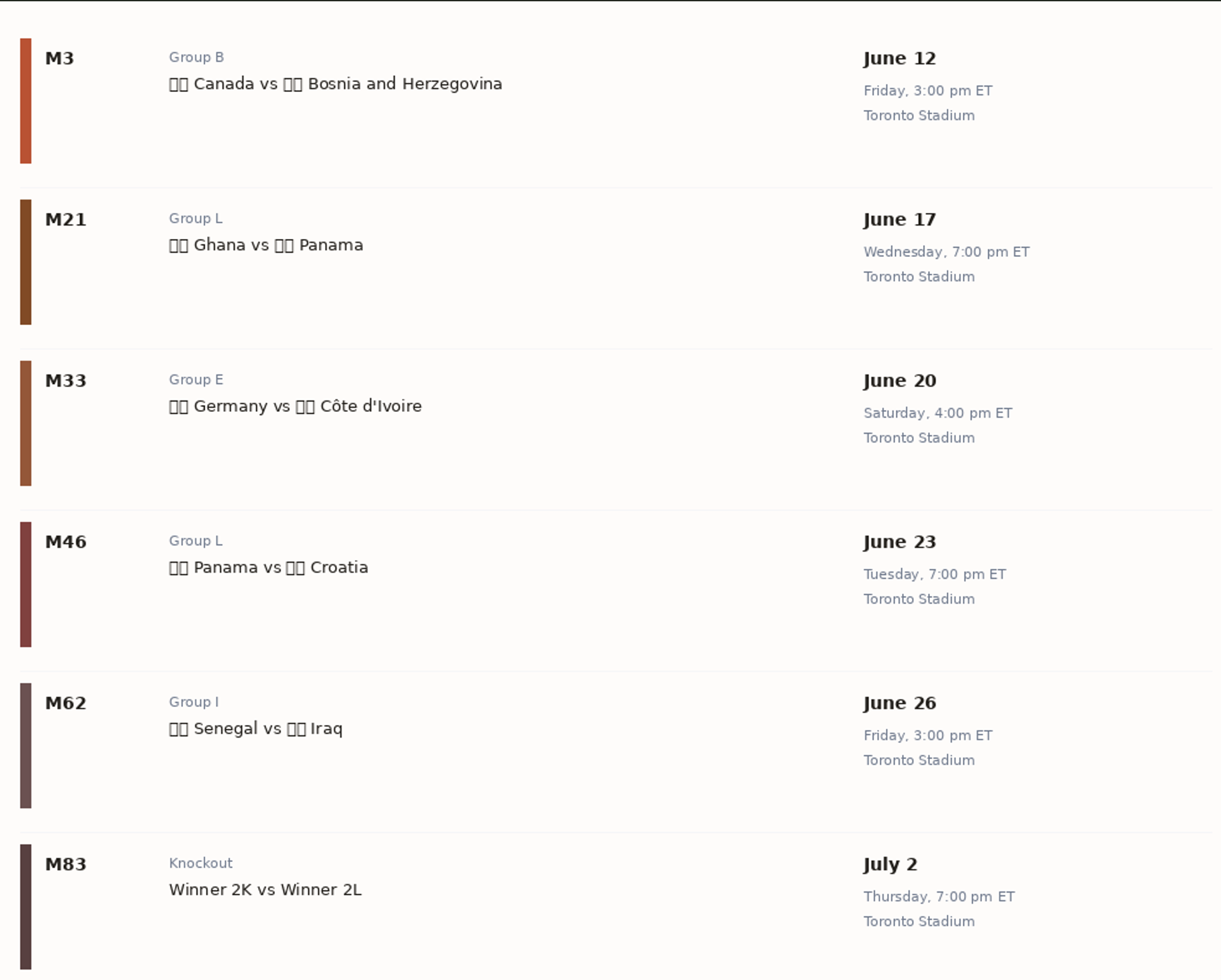
Toronto is hosting six World Cup matches across three weeks in summer 2026. The matches anchor your schedule. Everything else is planning around them.
The stadium is in the Entertainment District. It's downtown-adjacent, walkable to restaurants and bars, but surrounded by corporate hotels and chain restaurants. That's not where you want to spend your non-match time.
Here's the rhythm: Match days are structured (you have a start time, you need to be there). Non-match days are yours. Plan your neighbourhood exploration on days without matches. Plan your recovery on match day evenings. The city spreads out in all directions. You have time to actually see it.
Where You're Staying and What That Means
Most international fans book hotels in three zones: the Entertainment District (stadium-adjacent), King West (nightlife, restaurants), or the Waterfront (quieter, tourist infrastructure).
Your hotel location determines your whole first impression of the city. Here's what matters:
Entertainment District:
Walking distance to the stadium. Packed with other fans. Chain restaurants, expensive drinks, designed for people spending money fast.
Good if you want to roll out of bed and walk to kickoff. Bad if you want to see Toronto.
King West:
The restaurant and bar core. Walkable to the stadium (15 minutes), walkable to actual neighbourhoods (10 minutes west to Kensington, south to St. Lawrence).
Better energy than the Entertainment District. Louder nightlife. More options.
Waterfront/St. Lawrence:
Quieter. Charming old Toronto feel. St. Lawrence Market is here. Walkable to Old Town and the Distillery District.
Takes 20 minutes to get to the stadium by transit. Worth it if you want less chaos.
Pick based on whether you want to be in the action (King West) or have a neighbourhood base to explore from (Waterfront or King West, which has both).
The Tourist Traps (Read This Before You Spend Any Money)
Toronto has some genuinely world-class attractions. It also has some genuinely overpriced, undersatisfying experiences designed to extract money from people who don't know better.
Skip: The CN Tower at night. The views are real, but you'll spend two hours in line for 20 minutes in a rotating room with 500 other people. The cost is brutal ($40+ per person). Locals skip it. So should you.
Skip: Ripley's Believe It or Not. This is a wax museum designed for people with nowhere else to go. Toronto has actual things to do.
Skip: Tourist trap restaurants on King West. The ones with the huge patios packed with people wearing team jerseys. The food is fine, the price is triple what it should be, and you're sitting with 500 other tourists. There are better options 10 minutes away.
Skip: Niagara Falls as a day trip. It's two hours away. People do it. They spend more time in transit than at the Falls. Unless you specifically came to see Niagara Falls, stay in Toronto.
Do: The things actual Torontonians do. Go to the neighbourhoods. Eat at restaurants where locals eat. Sit in parks. Walk slowly. The city reveals itself when you're not rushing to check boxes.
.jpg)
How to Eat Like You Live Here
Toronto's food scene is built by immigrants. Portuguese, Korean, Chinese, Greek, Italian, Caribbean every community that moved here cooked the food they knew. The result is some of the best, most authentic, most affordable cuisine in North America.
The trap: Eating at tourist restaurants on King West or near the stadium.
The move: Eat where Torontonians eat. Here's where to go, based on your location and how much time you have.
If You're Staying Near the Stadium or King West
You're actually close to three incredible neighbourhoods. The streetcar runs directly to them.
Kensington Market (10 minutes west on the 505 Dundas streetcar): Chaotic, colourful, alive. Seven Lives Tacos for the best fish tacos in the city. Order the gobernador (smoked marlin, cheese, chipotle). Arrive before 10am to avoid the queue. Sunny's Chinese for Michelin-level Cantonese comfort food. It's in the basement of Kensington Market Mall. Easy to walk straight past if you don't know it's there. Stop anywhere that calls to you. The market tells the story of Toronto through what people are selling and buying.
Little Portugal (15 minutes west, 505 Dundas): Hand-painted azulejo tiles on restaurant fronts from the 1950s next to newer places. Taberna LX for duck rice and house-cured chorizo. Cafe Belem for pasteis de nata. Stand outside to eat it. Alma Lusa for grab-and-go bifanas. Patois for an Asian-Caribbean menu that doesn't fit any category and doesn't need to. Walk slowly. The storefronts tell 60 years of Portuguese history in Toronto.
St. Lawrence (10 minutes south, King Streetcar to Parliament, then walk): The oldest neighbourhood in Toronto. St. Lawrence Market has been operating since 1803. Saturday mornings are busiest. Come early for peameal bacon sandwiches. Greek, Portuguese, Chinese vendors selling prepared food. The Gooderham Building (the iconic flatiron) is here. Light, bright, actually authentic Toronto.
If You're Staying at the Waterfront/St. Lawrence
You're already in one of the best food areas in the city. Stay here and explore outward.
Right here: St. Lawrence Market. Peameal bacon sandwich. Prepared food from a dozen vendors. Sit on the waterfront.
East to Greektown and the Danforth (15 minutes by subway): Myth for Greek food that doesn't compromise and a wine list that proves the point. Opa for casual Greek and excellent mezze. Traditional Greek bakeries. The energy is multi-generational families and people who've lived here for 50 years. Sit outside. Stay late. Eating is communal here.
West to King West (Streetcar, 15 minutes): See above Kensington, Little Portugal, all accessible from King West.
General Rules for Eating Like a Torontonian
Go early. Arrive at restaurants before peak hours (before 7pm). You'll get a table, prices feel reasonable, you'll see actual neighbourhood people, not just tourists.
Order what locals order. Ask staff what's good. Ask what they'd order if they were staying one more day. Follow their recommendation.
Expect to queue. Good cheap food has a line. Seven Lives, Sunny's, the market vendors they're worth 15 minutes standing.
Skip chains and branded restaurants. Every chain restaurant exists everywhere. You're in Toronto to eat things you can't get at home.
Eat in neighbourhoods, not near tourist infrastructure. The restaurants near the stadium and the main tourist zones are expensive and mediocre. Everything gets better the farther you walk from the Entertainment District.
Adventures and Sightseeing (The Real Version)
Toronto isn't about one big attraction. It's about neighbourhoods, each with a distinct character and reason to spend time there.
Here's where to go based on what you want to do.
If You Want History and Old Toronto
Old Town and St. Lawrence The oldest continuously inhabited neighbourhood in Toronto. St. Lawrence Market since 1803. Georgian and Victorian architecture. The Gooderham Building lit up at night. Walk slowly. Read the signs. The architecture is a timeline of Toronto.
The Distillery District A preserved industrial complex from the 1830s turned into a village. Cobblestone streets. Galleries. Artist studios. The Mill Street Brew Pub on site. Summer outdoor markets. The scale is human. It feels completely different from downtown.
If You Want Culture and Local Life
Kensington Market No chains. A fishmonger, vintage shop, and taqueria share a half-block. Murals painted over murals for decades. Used bookstores. Korean supermarkets next to Italian bakeries. It's chaos and character in equal measure.
The Annex and Harbord Village University culture meets actual neighbourhood. Used bookstores (Serendipity, Courage My Love). Cafes where people sit for hours. Intellectually alive. Victorian architecture. Walk the side streets.
Greektown and the Danforth Multi-generational families. People who moved here in the 1950s still run restaurants. Street-oriented. People actually sit outside in summer until midnight. Late-night, social, food and wine focused. The energy is rooted in community, not tourism.
If You Want to Just Walk and Not Plan
Pick a neighbourhood from our neighborhoods guide and spend three hours there. Here's what that looks like:
Walk a main street slowly. Stop in shops that call to you. Get coffee. Sit in a park. Talk to people. Don't plan it. There are many neighbourhoods to discover in Toronto, each designed for walking. Streets are built for people, not traffic.
Recommended for walking: Queen West, Kensington, Harbord Street, Ossington Avenue.
The Neighbourhoods Worth Your Time
Toronto is a city of neighbourhoods. Each has a personality. Here's where to go based on what you want to experience.
Central Toronto (Closest to Stadium, Most Walkable)
Kensington Market: See above. Go early morning for the quiet before the chaos. Return in the evening for bars and live music. Ronnie's Local 069 for live jazz in a room that barely holds 100 people.
Little Portugal: See above. Lula Lounge on Dundas West for live salsa and Brazilian music with dinner-and-show packages on weekends.
Queen West and Trinity Bellwoods: A dive bar, a Michelin-starred restaurant, and a laundromat sit next to each other. DaiLo for dim sum brunch. Actinolite for seasonal Canadian cooking. Paris Paris for natural wine and small plates. Trinity Bellwoods Park is 14 acres of grass in the middle of the city. Summer Sundays are packed with musicians and people with nowhere better to be.
King West: Where Toronto's real restaurant scene lives. Alo if you've planned weeks ahead. Giulietta for Michelin-level handmade pasta, no reservations for bar seating. The Carbon Bar for smokehouse BBQ. Bar Raval for Spanish-French small plates. Michelin-starred restaurants sit next to dive bars. Both are full on a Tuesday night.
Old Town and St. Lawrence: See above. The Gooderham Building at night is worth a photo. Taverna on Wellington for real Italian. The waterfront is blocks south.
West End (20-25 Minutes by Streetcar)
The energy shifts from intensive urban to neighbourhood living. Each has a distinct character.
Koreatown: An entire neighbourhood built around one cuisine, one culture. Korean families shopping for ingredients. Korean restaurants where elders cook like they've cooked for fifty years. Hawkers for Korean street food. Goro Ramen for Tokyo-style ramen. Noraebang for Korean karaoke in small rooms. Small rooms, real singing, no performance pressure. The energy is working culture, not tourist culture.
The Annex and Harbord Village: Where the University of Toronto meets actual neighbourhood. Books, university culture, cafes where people stay for hours. Used bookstores on Bloor Street between Spadina and Bathurst. Serendipity. Courage My Love's sibling location. Walk slowly. The side streets have smaller shops and quieter cafes. Harbord Street is quieter than Bloor, bookish, local. The University of Toronto campus is beautiful architecture worth walking through.
Yorkville: Where money lives in Toronto but without the performance. Quiet, tree-lined, expensive. Old money next to new money, both living their lives. Tree-lined streets reward walking slowly. Galleries are worth popping into. Bookstores are worth browsing. The energy is quiet. People live here because it's beautiful, not because they need to perform beauty.
East End (15-20 Minutes by Subway)
Further from downtown, less intensive urban. More neighbourhood character.
Greektown and the Danforth: See above. Greek families who moved here in the 1950s still live here, run restaurants, gather on the street. Multi-generational and real. Myth for Greek food that doesn't compromise. Opa for casual Greek and excellent mezze. Various traditional Greek bakeries. Danforth Summer activities: patios packed until midnight. The energy is social. Eating is communal. Wine bars where the focus is on actual wine. The scene is rooted in culture, not performance.
The Distillery District: See above. A preserved industrial village. The Mill Street Brew Pub. Artist studios with working artists. Galleries. Summer outdoor events. It feels completely different from downtown Toronto. Walk the cobblestones slowly.
Scarborough: The neighbourhood Toronto proper doesn't acknowledge but where actual Torontonians live. Diverse, multicultural, working. Not oriented to tourists. Scarborough Bluffs are dramatic cliffs on the waterfront. Guild Park and Gardens on the waterfront is beautiful. Authentic restaurants reflecting actual demographics. Vietnamese pho where the noodles are made in house. Indian food from actual imported spices. Portuguese food where actual Portuguese families eat.
Getting Around Without Losing Your Mind
Toronto's transit is good but not intuitive to visitors. Here's what you need to know.
The Streetcars: Run in specific corridors (Dundas, King, Queen, College). They're slower than the subway but cheaper and more scenic. You see the neighbourhood as you move. The 505 Dundas goes directly from downtown west to Kensington and Little Portugal. The 501 Queen goes to Queen West.
Walking: Toronto is walkable. King West to Kensington is a 15-minute walk. King West to St. Lawrence is a 10-minute walk. Most neighbourhoods are connected by easy walking.
Taxis and ride-share on match days: Avoid. Everyone else is also leaving the stadium. Prices surge. Transit is faster. Plan to take the subway back to your hotel, not a cab.
Day passes: Buy a PRESTO card (reloadable transit card). Or buy a day pass if you're doing heavy transit. It's cheaper than multiple single trips.
Timing tip: Plan your transit around match start times. The subway gets packed 90 minutes before kickoff and jammed an hour after final whistle. If you're exploring a neighbourhood, stay there until the crowds clear (usually two hours after the match ends) or go early, before people head to the stadium.
Your Tourist Cheat Codes
Things that will make your trip easier and better.
Arrive at restaurants before 9am or after 3pm. You'll get a table. You'll pay less. You'll see actual neighbourhood people, not tourists.
Don't eat near the stadium or the Entertainment District. It's 10 minutes by streetcar to Kensington. It's 15 minutes to King West. Prices drop by 40%. Quality jumps by 200%.
The corner of Nassau and Dundas in Kensington. Arrive before 8am. The neighbourhood is quiet. The bakeries are fresh. There's coffee. It's Toronto before it wakes up.
Bloor Street between Spadina and Bathurst (The Annex). Walk this block slowly. Every storefront is a used bookstore, a cafe where people sit for hours, or an independent shop. Spend an afternoon here. It's the intellectual heart of the city.
Danforth Avenue after 8pm in summer. Patios are packed. The energy is late-night, social. Wine bars are full. It's where Torontonians actually go at night, not tourists.
Take the 504 King Streetcar east to Parliament, then walk south to the Distillery. It's a complete walk through old Toronto. Takes 25 minutes. Costs $3.25. Shows you three centuries of the city.
The park at the northeast corner of King and University. There's a bench. Sit for 15 minutes. Watch the city move. King Street is pure Toronto.
If you have an afternoon with no match: Pick a neighbourhood from this guide you haven't been to. Go there. Eat lunch. Walk for two hours. Sit in a park. Don't plan it beyond that. The neighbourhoods reveal themselves when you're not rushing.
Final Notes
You're here for 90 minutes of soccer. That's real. But you've got three weeks. That's the actual gift. Toronto reveals itself to people who slow down enough to see it. The best neighbourhoods aren't the ones in guidebooks. They're the ones where Torontonians actually live and eat and spend time.
Go to the match. Enjoy it. But spend the rest of your time in the neighbourhoods. Eat where locals eat. Sit in parks. Walk slowly. Talk to people. The city is better when you treat it like home, not a checkbox.
See you here.
Want Deeper Dives on Specific Neighbourhoods?
See our full Toronto Neighbourhoods Guide for complete breakdowns on where to eat, what to see, how to get there, and what makes each neighbourhood unique. Every neighbourhood mentioned here has a full guide with specific restaurants, shops, bars, and local tips.
The guide covers 11 neighbourhoods across the city. Whether you're exploring for 48 hours or three weeks, you'll find exactly where to go based on what you want to experience.
Frequently Asked Questions
Where is BMO Field in Toronto? BMO Field is located in the Entertainment District at 170 Princes' Boulevard. It's downtown-adjacent, walkable to King West (15 minutes), and accessible by the Lakeshore streetcar or a short taxi ride. The stadium sits on the waterfront edge of downtown Toronto, close to restaurant and nightlife districts.
What neighborhood is near BMO Field? The Entertainment District surrounds the stadium. It's corporate, chain-focused, and not where you want to spend non-match time. Better neighbourhoods are 10-15 minutes away: King West (restaurants, bars, nightlife), Kensington Market (chaotic, authentic, food-focused), St. Lawrence (historic, market-oriented), and the Distillery District (galleries, creative space). Most fans stay here but explore outward.
Should I rent a car in Toronto? No. Don't. Transit is cheap and good. Streets are walkable. Parking is expensive. You'll see more on foot and transit than you ever would from a car. The city is designed for pedestrians and public transit. Use the streetcar (Dundas, King, Queen lines) or subway (Red line runs north-south through downtown).
Do I need to plan my entire trip around match times? No. The matches are scheduled, yes. But you have six matches across three weeks in summer 2026. That's a lot of unstructured time. Plan your match days around the schedule. Use non-match days to explore neighbourhoods. You're not here just for soccer.
What's the best neighbourhood for first-timers to Toronto? Kensington Market or King West. Both are walkable from downtown, close to the stadium, and have everything a first-time visitor needs: food, bars, shops, and actual Toronto culture. From there, everything else is accessible by streetcar or a short walk.
Is it safe to walk around Toronto at night? Yes. Toronto is safe. Neighbourhoods are lit, busy, and social. Locals walk everywhere at all hours. Follow normal city sense (don't flash money, stay aware) and you're fine.
What's the actual cost of eating out in Toronto? A great meal at a local restaurant costs $15-25. Drinks are $6-10. Coffee is $3-5. Tourist restaurants near the stadium charge triple. Eat in neighbourhoods, costs drop significantly.